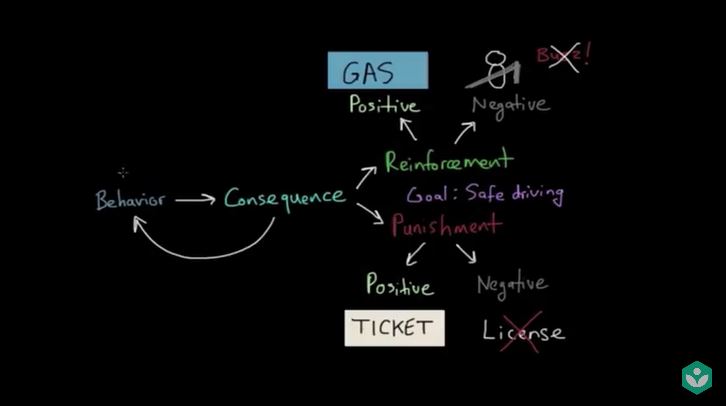
Before you get confused, let me show you this screenshot.
Vocabulary: Operant Conditioning
Meaning: It is a process of learning where a certain behavior is associated with a consequence. In this process, there is a specific target behavior that we want to achieve. To achieve such, we control the behavior through the consequences of actions, as seen in the above screenshot. This image illustrates that operant conditioning works as a cycle of behavior and consequence.
On the photo above, the goal behavior is “Safe Driving.” However, I will not talk about the process on the photo. Instead, I am taking you to a Filipino home to see how operant conditioning has been used by parents to encourage their children achieve high grades in school.
When I was ten years old, the goal behavior in our house was to get academic grades of 90 and above. Anything less than 90 will have a consequence. Consider the illustration below of how operant conditioning worked during my elementary days. Other Filipino homes are possibly using the same behaviorist approach.
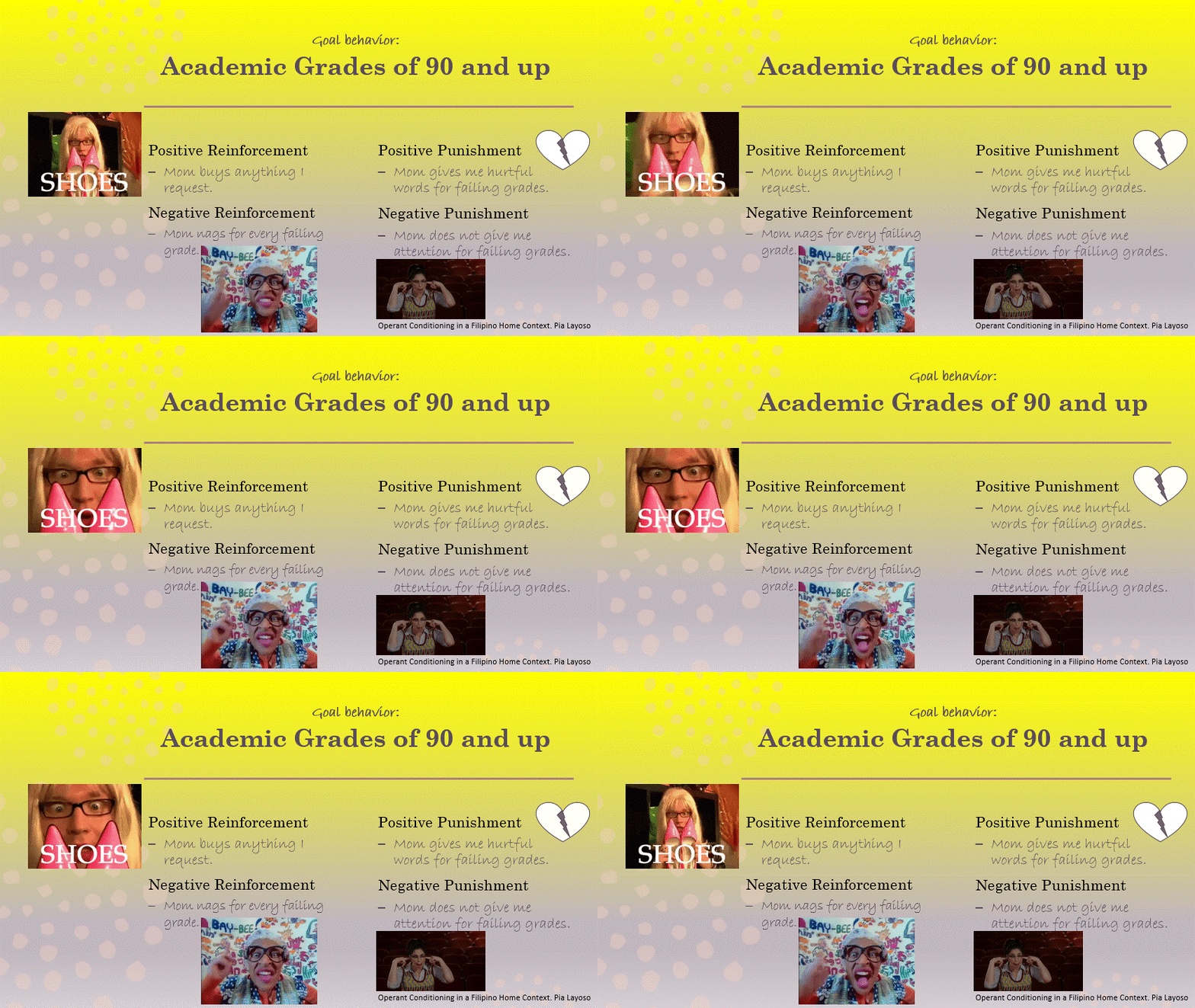
A positive reinforcement is something that I receive when I achieve the goal behavior. I get a new pair of shoes, for example, for getting 90 and up in my academic grades.
A negative reinforcement is something that I don’t want to happen when I don’t achieve the goal behavior. I don’t want the noise of my mom nagging when I fail. Hence, I will do my best getting high academic grades.
A positive punishment is something that I get even though I don’t want it—because I fail to achieve the goal behavior. In this example, I don’t want to hear hurtful words from my mom, but I hear words such as “You are weak.” “You are just not good.” because I fail to achieve the goal behavior.
A negative punishment is something that is taken away from me when I fail to achieve the goal behavior. In this example, my mom withdraws her attention from me when I get academic grades lower than 90.
Consequently, these behaviorist approaches lead me to become an academic achiever. I graduated Salutatorian in elementary and in high school. I was also a partial-scholar and a Dean’s Lister in college. However, these approaches had a negative effect in my morale. Pushing me as a child to always get high academic grades made me feel that my value inside the house only depended on my academic achievement. If I were not an honor student, I would feel like I did not exist inside the house and nobody really cared about me. Such impact grew deeply in my subconscious until adult years. I became an achiever in everything especially in the workplace. But, the pressure of achieving eventually lead me to frustration. When our family business closed down because I could not manage its sustainability; when I lost my income because I resigned from my Managerial post; when my long-time relationship failed; when I could not push through with Singapore Management University because I had no source of living because our business failed—my life was devastated. The pressure just got into me, and I felt worthless. My life and all those achievements felt worthless.
Having shared these adverse effects of punishment in a child, I highly suggest for parents to build a solid foundation of love and trust relationship with their children before doing any kind of operant conditioning. To me, operant conditioning will only become balanced inside the house if the parents can build this solid foundation in their children’s mind and heart first. Hence, the parents can always correct a wrong behavior with love. Reinforcement and punishment can be chosen properly to avoid planting bitter roots in the children’s heart. And, when giving reinforcement or punishment, a good talk between the parents and the children will help the children understand the consequences of their behavior. A solid foundation of love and trust relationship will always result in better little people inside the home, in school, and eventually, better adults in our community not only in a Filipino but also in a global context. Isn’t this what we all want after all—something better?
 Better Teachers
Thank you for this very insightful post. It is true that operant conditioning can be effective to a certain degree, however, it becomes problematic when parents become legalistic and send the message that their kid’s value is based on their educational accomplishments. Thank you for sharing these personal experiences, and I hope that as life-long learners we understand how these behaviorists principles influence how we feel, think, and view the world as educators.
LikeLike