Santrock. Online Learning Center.
http://www.mhhe.com/socscience/education/edpsych/santrocked02/ch07a_sa.html
Having positive role models and mentors can make an important difference in whether individuals develop optimally and reach their full potential. First, evaluate the role models and mentors who have played an important part in your life. Second, think about the type of role model you want to be for your students. Third, give some thought to how you will incorporate other models and mentors in your students’ lives. Fourth, explore who your education mentor might be.
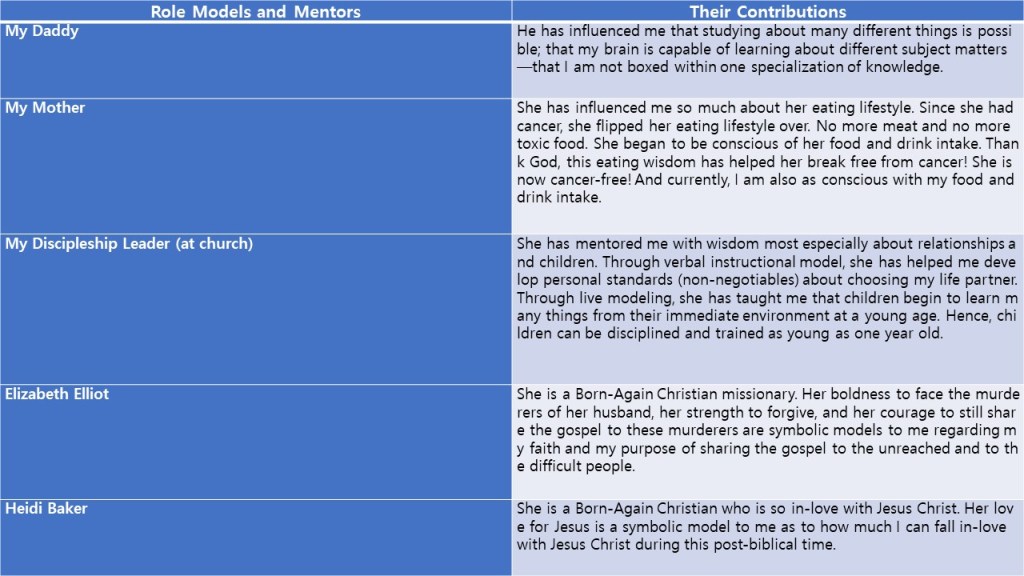
My Models and Mentors
List the most important role models and mentors in your life. Then describe what their positive modeling and mentoring have meant to your development.
The type of role model I want to be for others (other learners)
Describe which characteristics and behaviors you believe are the most important for you to model for your students.
| 1. Vulnerable and open for correction |
| 2. Self-encouraged and self-motivated |
| 3. Vision and purpose driven |
| 4. Laughs a lot, takes life easily, and joyful in all situations |
| 5. Chooses to forgive and to love even the people I do not like. Peace is not dependent on my surroundings. |
How I will incorporate models and mentors in my profession (as an educator)
Describe a systematic plan for bringing models and mentors into your students’ lives in one or more domain(s) you plan to teach, such as math, English, science, music, and so on.
I teach English as a Second Language to Cambodian children. I can apply Bandura’s three types of modeling in my classroom:
- For live modeling, I want the students to see their English teachers (not only me but also the other English teachers) as their live models in their faith, in making good choices everyday regardless of how simple the choice is (e.g. to eat or not to eat vegetables; to shout or not to shout), and in respecting each other. In addition, I always allow my students to work in pairs so that they can teach each other. The other student can learn the way the other student processes the seatwork and the lesson.
- For verbal instruction modeling, I am my student’s immediate mentor. As I observe their learning process and progress every day, I also develop different strategies and activities to help them acquire the knowledge and to develop the behavior that is good for their independence and self-efficacy.
- For symbolic modeling, I always plan appropriate films for my students. For example, I want to address the issue of quitting easily when something is difficult. Hence, before our Sports Festival, our class watched the film “Karate Kid” where the students learned to do self-encouragement by saying “Go back up!” in every failure. It was effective as per my experience.
Who will be my education mentor? What would my ideal education mentor be like?
Do you have someone in mind who might serve as an education mentor when you become a teacher? If so, describe the person.
As of now, I have no idea about my education mentor. I don’t have one, so far, except for the greatest Teacher of all—Jesus Christ. When He was still on Earth, He taught with love. This is the only model and teaching system I have.
What would your ideal education mentor be like?
My ideal education mentor is:
1. Self-encouraged and self-motivated
2. Applies wisdom in all decisions and choices
3. Vision and purpose driven
4. Strategically applies a system that does not teach per se; instead, such system facilitates learning
5. Applies SMART goals for the leaners (Specific. Measurable. Attainable. Relevant. Time-based).
 Better Teachers